Introduction: The Unsung Hero of Measurement
In a world driven by precision, the humble load cell plays a pivotal role.
From weighing scales in your kitchen to complex industrial automation systems, load cells are the fundamental sensors that convert force into measurable electrical signals.
But how does this critical component actually work?
At Goodprox, a leader in precision sensor technology, we're demystifying the science behind load cells and exploring our specialized solutions like miniature load cells, beam load cells, button load cells, and S-type load cells etc,.
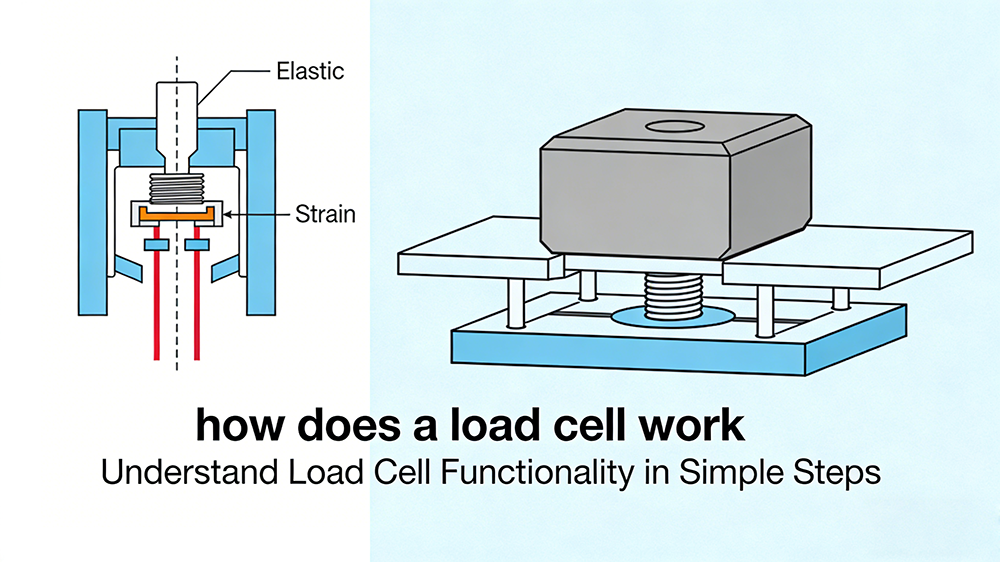
The Core Principle: Strain Gauges and the Wheatstone Bridge
At its heart, a load cell's operation relies on the piezoresistive effect and a clever electrical circuit called a Wheatstone bridge. Here’s a simplified breakdown:
- Deformation: When a force (load) is applied to the load cell, the metal structure (often made of aluminum or stainless steel) deforms slightly. This deformation is called "strain."
- Resistance Change: Tiny sensors called strain gauges are bonded to the strategic points of this metal body. As the body deforms, the strain gauges stretch or compress, causing a predictable change in their electrical resistance.
- Electrical Signal Output: These strain gauges are connected in a Wheatstone bridge configuration. The minute changes in resistance unbalance the bridge, producing a small, proportional millivolt-level output signal.
- Signal Interpretation: This output signal is then sent to a weight indicator or transmitter, which amplifies and converts it into a readable digital display (e.g., weight in kg or lbs) or a process control signal.
Choosing the Right Load Cell for Your Application
The basic principle is consistent, but the design varies drastically based on the force type (tension, compression, shear), capacity, space constraints, and environmental conditions. This is where Goodprox's diverse product range ensures you find the perfect fit:
Miniature Load Cells: Ideal for applications with severe space limitations, such as medical devices, robotic end-effectors, or small-scale precision testing. Goodprox miniature sensors deliver high accuracy in a tiny package. (For example, we have GP-LC-HW113 with the mini size 8*6.5mm only.)
Beam Load Cells (Bending Beam): Commonly used in platform scales, bench scales, and industrial weighing. They are cost-effective, robust, and suitable for medium-capacity weighing.
Button Load Cells (Pancake Load Cells): Designed primarily for compression loading. Their low-profile, compact "button" design makes them perfect for tight spaces like bolt force monitoring, structural testing, or modular weighing systems.
S-Type Load Cells: Named for their "S" shape, these are versatile sensors capable of measuring both tension (pulling) and compression (pushing) forces. They are widely used in hoist scales, hanging bins, and material testing machines.
Why Partner with Goodprox?
Understanding how a load cell works is the first step. Choosing a reliable one is critical.
Goodprox load cells are engineered for:
High Accuracy & Repeatability: Consistent, dependable measurements.
Robust Construction: Built to withstand harsh industrial environments.
Variety: From sub-gram precision to high-tonnage capacity, we have a solution.
Expert Support: Our team helps you select the ideal sensor—be it a beam load cell for a conveyor or a miniature load cell for your innovative prototype.
Conclusion
Load cells are marvels of practical engineering, turning invisible force into actionable data. Whether your project requires the compact strength of a button load cell, the versatile S-type load cell, or any other configuration, the core principle remains the same. For precision you can trust, explore the Goodprox range of advanced force sensors.
Ready to measure with precision? Contact Goodprox today to find the perfect load cell for your application!


